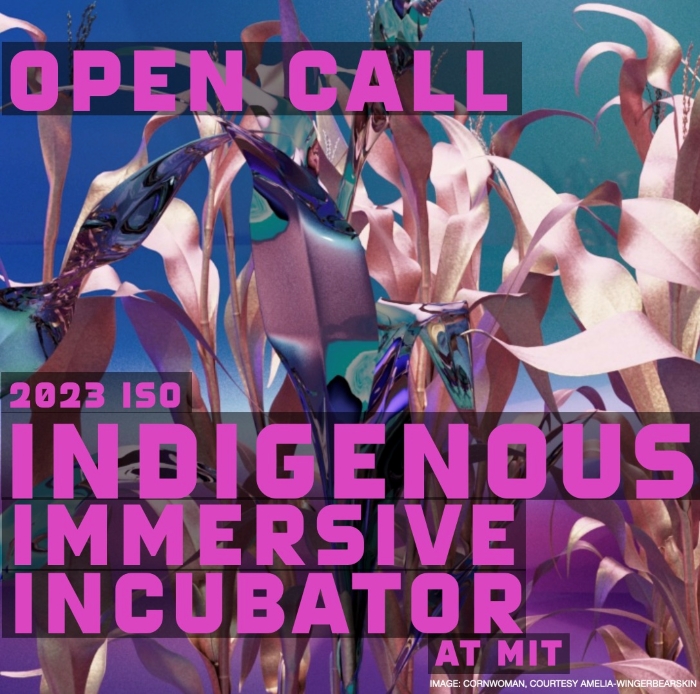
The application form can be found here.
The Indigenous Screen Office (ISO) is collaborating with the Co-Creation Studio at MIT Open Documentary Lab to offer an intensive four-day incubator for mid-career and established Indigenous screen-based artists with ideas for Immersive and/or Interactive projects in development. Experience with immersive or interactive technology(ies) may be helpful but is not required for consideration. The focus of the Incubator is to support creators developing projects using emerging technologies (such as artificial intelligence, virtual reality, augmented reality, game engines or robotics etc.) or using “old tech” (projections, multichannel video, console video games, VFX, 3D, web, social media storytelling, transmedia storytelling, etc.) in new and inventive ways. Feel free to surprise us with your ideas!
Up to 4 selected participants (including either individual creators or teams of two) will have the chance to engage in-person at MIT for an incubator focused on Immersive and/or Interactive projects. Applicant ideas will be shared, discussed, workshopped, and expanded upon throughout the incubator with the support of MIT’s community of researchers, creators and technologists.
Co-Creation Studio is also offering a parallel application process for one incubator fellow for a U.S.-based Native American, Native Hawaiian, Alaskan Native creative link here. The financial support for the US-based fellow is independent from ISO.
WHAT YOU GET
1 – At Co-Creation Studio MIT Open Documentary Lab, successful applicants participate in a tailored programme of inspiring lectures, hands-on workshops, mentorship and one-on-one sessions. The program will cover an overview of co-creation methods and in-depth case studies and screenings along with guided group workshops to develop participants’ own projects and action plans for their work. There will be a strong emphasis on reciprocity and peer-to-peer support amongst the cohort. The facilitators include Co-creation Studio artistic director Katerina Cizek, Lead Artist Amelia Winger-Bearskin, and invited guests.
The successful participants must be available for a design process that will include up to three ideation and planning sessions during the spring of 2023, resulting in an intensive 4 days of on-campus incubation (April 23 – 26, 2023).
2 – A $20,000.00 CAD contribution from ISO towards the research and development of an Immersive and/or Interactive project.
3 – A stipend toward travel and living expenses, and fully paid accommodation while at MIT, in Cambridge, Massachusetts for the duration of the incubator (April 23rd – April 26, 2023).
ELIGIBILITY REQUIREMENTS
APPLICATION REQUIREMENTS
KEY DATES
Please note, applicants must be able to commit to all of the following dates in order to be eligible.
Final dates and times for virtual meetings will be confirmed with successful applicants.
SELECTION PROCESS
The ISO and MIT will collaborate on an internal assessment and selection process of the submitted applications.
The selection process will focus on:
FAQ
Q: Do I have to be associated with a university, or in the academic community?
A: No, this is for Indigenous screen based artists who are mid-career or established, who have an idea for an Immersive and/or Interactive project, or have a project incorporating Immersive/Interactive technology.
Q: What does mid-career mean?
A: Mid-career generally means several credits in one or several roles, and a substantial history of successfully creating projects, accepting funding, and collaborating with other creatives.
Q: Does my project already need confirmed funding in order to be eligible?
A: No, your project does not need confirmed funding and can be in the early stages of development.
Q: Do I need to have created Interactive or Immersive works already?
A: No, but applicants must be mid-career in other formats, and express interest in developing their practice in these fields. Priority will be given to creators who have already produced, or collaborated in Immersive or Interactive works.
Q: Does my project have to be in English?
A: No, but the incubator will take place in English.
Q: What happens to the IP of my project if I develop it further at the incubator?
A: All participant confidential information and/or intellectual property shall be the sole property of the participant, and used only with permission in writing from the individual participant or teams.
Q: My project is in early development, and the pitch materials I submit now will likely change as I move forward.
A: That is totally acceptable. We expect — and hope there will be — changes in your approach, concept, schedule, creative materials, etc.
*Please note, for purposes of ISO funding, Indigenous in the context of First Peoples in Canada includes:
Apply here.
Please reach out to funding@iso-bea.ca if you have any questions.
DESCRIPTION OF PARTNERS
CO-CREATION STUDIO AT MIT OPEN DOCUMENTARY LAB
Founded in 2016, the Co-Creation Studio is an initiative at MIT Open Documentary Lab. The studio researches and incubates collective creation (alternatives to a singular authorial vision), through a constellation of media methods. For us, co-creation can occur within communities, across disciplines and with non-human systems such as Artificial Intelligence, as outlined in our book, Collective Wisdom: Co-Creation Media for Equity and Justice. We work within the context of the MIT Open Documentary Lab, where we bring together storytellers, technologists, and scholars to explore new documentary forms with a particular focus on collaborative and immersive storytelling. A center for documentary research, the lab offers courses, workshops, a fellows program, public lectures, and conferences; it incubates projects; and it develops resources and critical discourse. Projects incubated at our lab have premiered at Sundance, Venice, Tribeca festivals and have won Emmys and Webbys, Ars Electronica along with many other global awards. In the spirit of MIT’s open courseware and open source software movements, the Open Documentary Lab is inclusive, collaborative and committed to sharing knowledge, networks, and tools.
INDIGENOUS SCREEN OFFICE
The Indigenous Screen Office (ISO) is an independent national advocacy and funding organization serving First Nations, Inuit and Métis creators of screen content in Canada. The ISO’s mandate is to foster and support narrative sovereignty and cultural revitalization by increasing Indigenous storytelling on screens and promoting Indigenous values and participation across the sector.
Image source: Cornwoman, courtesy Amelia-Wingerbearskin